
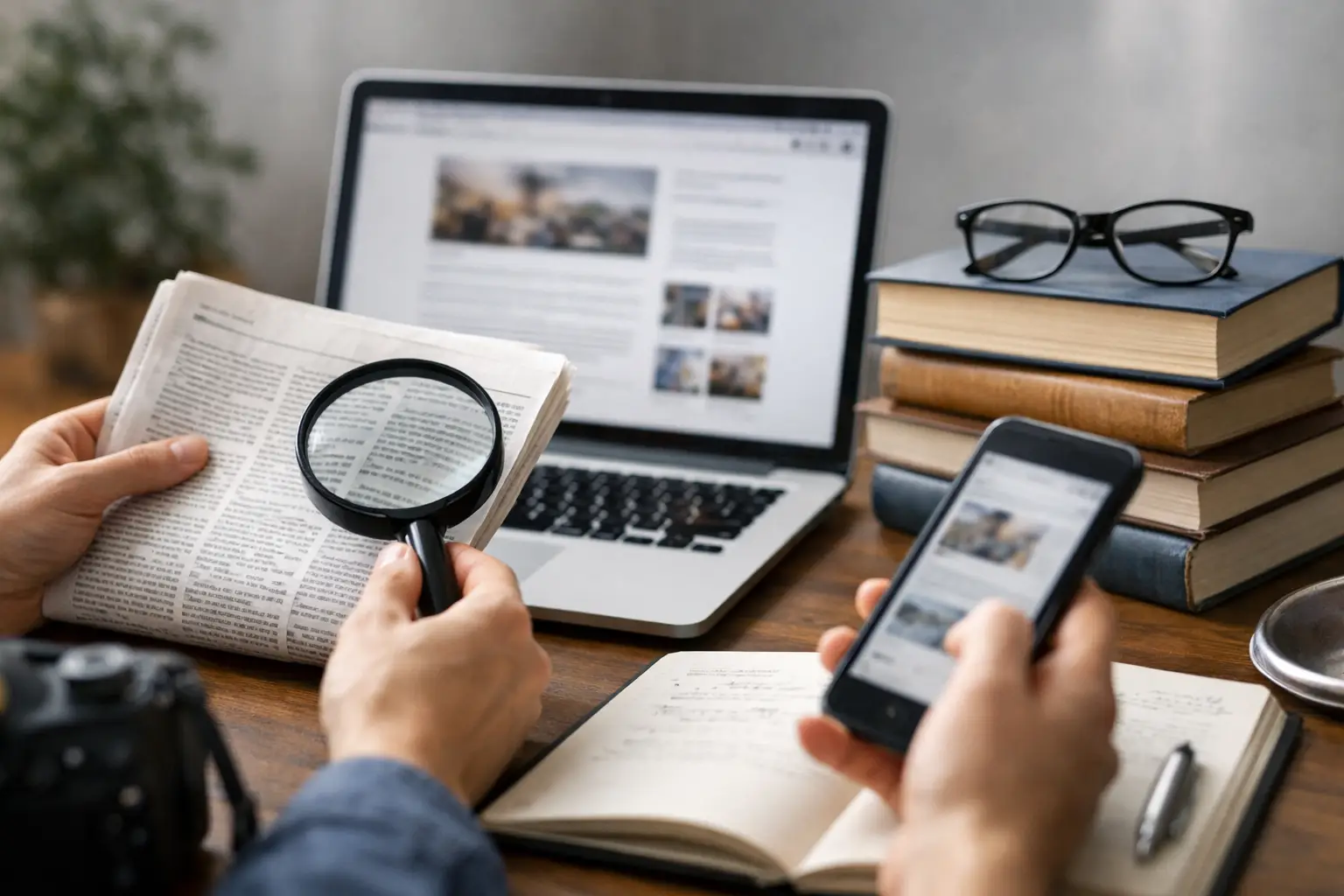
A confident briefing can still be built on weak foundations. The risk is not always obvious fabrication. More often, it is a plausible claim repeated often enough, cited selectively, or stripped of context until it appears decision-ready when it is nothing of the sort. That is why the best ways to verify sources matter well beyond journalism or academia. For executives, investors, policy teams and institutional leaders, source verification is part of risk control.
In high-stakes environments, verification is not a box-ticking exercise. It is a disciplined method for deciding what can be trusted, what needs further testing, and what should be excluded from the decision cycle altogether. Speed matters, but speed without validation simply accelerates error. The right approach is to move quickly while preserving evidential standards.
The best ways to verify sources start with provenance
The first question is not whether a source sounds credible. It is where the information originated, who produced it, and under what conditions. Provenance establishes the chain of custody of a claim. If that chain is unclear, confidence should drop immediately.
A primary document issued by a regulator, court, ministry, listed company or recognised institution usually carries more weight than a secondary commentary quoting it. That does not make primary material automatically reliable. Governments can frame, companies can omit, and institutions can make errors. But provenance gives you a firmer starting point than a recycled assertion on social media or in a poorly sourced article.
This matters especially when claims move across platforms. A figure cited in a market note may trace back to an old press release. A quote used in a policy memo may come from an unsourced screenshot. Verification begins by tracing each important assertion back to its earliest accessible origin. If you cannot locate that origin, you do not yet have a verified source. You have a repeated claim.
Test authority, but do not confuse profile with credibility
Senior titles, blue-chip logos and polished publications can create a false sense of security. Authority is relevant, but it is not decisive on its own. The real question is whether the source has direct knowledge, methodological competence and a record of accuracy in that specific domain.
An energy analyst may be highly credible on pricing dynamics and much less reliable on local political risk. A minister may speak authoritatively on policy intent while remaining an incomplete source on implementation realities. A company spokesperson may be the official voice of record, but also a strategically interested party. Verification requires a narrower lens than general reputation.
One useful discipline is to ask what the source could reasonably know first-hand. Another is to examine incentives. Sources with financial, political or reputational exposure are not worthless – often they are indispensable – but their claims need testing against independent evidence. Credibility increases when a source has expertise, access and limited incentive to distort. If one of those elements is missing, adjust confidence accordingly.
Cross-verification is one of the best ways to verify sources
A source becomes more reliable when its key claims are corroborated by independent reporting lines. Independence is the crucial word. Ten outlets repeating the same wire copy do not equal ten confirmations. Nor do multiple commentators citing the same original dataset.
The aim is to compare sources that differ in origin, interest and method. If a company statement is supported by customs data, satellite analysis, local reporting and supplier testimony, confidence rises. If all roads lead back to the same press office, confidence should remain constrained.
Cross-verification also helps reveal where a claim is true in part but misleading in meaning. A figure may be accurate, while the timeframe is selective. An incident may have happened, while the implied trend is unsupported. In strategic research, this distinction is vital. Decision-makers rarely fail because one fact was completely false. They fail because accurate fragments were assembled into the wrong conclusion.
Context determines whether a source is useful
Even a genuine source can mislead when separated from its operational setting. Verification therefore includes context testing. When was this produced? For whom? Under what pressures? What assumptions sit behind the data or statement?
A report from six months ago may already be stale in a fast-moving regulatory or conflict environment. A survey may be methodologically sound but irrelevant to your geography or stakeholder group. A local contact may offer sharp observations from one region while lacking visibility across the wider system. None of this makes the source invalid. It means the source has boundaries.
This is where experienced judgement matters. Executives do not need a pile of technically credible material. They need intelligence that is relevant to the question at hand. A verified source is only useful if it is current enough, specific enough and situated well enough to support the decision being made.
Examine the evidence underneath the claim
Strong sources show their workings. Weak ones ask to be trusted without revealing enough of the underlying evidence. When reviewing a source, look past the headline assertion and inspect the data, methods, citations and assumptions behind it.
If a report states that demand is rising, how was demand measured? If a briefing claims stakeholder sentiment is shifting, what sample supports that view? If a publication presents a forecast, what model inputs were used and how sensitive are they to change? The goal is not academic perfection. It is to understand whether the conclusion rests on observable evidence or interpretive overreach.
This is also where AI-assisted research requires discipline. AI can accelerate collection, summarisation and pattern detection, but it can also flatten distinctions between high-quality evidence and low-quality repetition. Human verification remains essential because it tests whether the output reflects the source material faithfully, and whether the source material itself deserves confidence. Used properly, AI compresses time. It should not compress standards.
Look for consistency over time
One of the most underused verification methods is longitudinal checking. A source may appear credible in a single moment, yet prove unreliable when examined over time. Has this outlet corrected major errors transparently? Has this expert made forecasts that held up? Has this institution changed methodology in ways that affect comparability? Has this contact provided information that was later confirmed or contradicted?
Consistency does not mean perfection. Credible sources can be early, partial or occasionally wrong. What matters is whether errors are honest, bounded and corrected, or whether the pattern shows exaggeration, selective framing or chronic overconfidence.
For leadership teams operating in uncertain conditions, a source history is often more revealing than a single impressive document. Verification improves when you treat source reliability as cumulative rather than binary. Trust is built through repeated performance, not presentation.
Distinguish between verification and validation
These terms are often blurred, but the distinction is useful. Verification asks whether the source is authentic, credible and accurately represented. Validation asks whether the resulting conclusion is sound enough to support action. You can verify a source and still arrive at a poor decision if the analysis is weak, the context is misunderstood or the evidence base is too narrow.
That is why the best ways to verify sources sit inside a broader intelligence process. Good source work should feed structured assessment, confidence grading and explicit acknowledgement of uncertainty. Not every question allows full confirmation before a decision must be made. In those cases, leaders still need clarity on what is known, what is probable and what remains contested.
In practice, this means avoiding false certainty. A disciplined team will say: this source is authentic, partially corroborated and contextually relevant, but it comes from an interested party and should be treated as medium confidence until supported by independent evidence. That language is more valuable than a simplistic credible or not credible label.
A practical standard for executive teams
For senior decision-makers, source verification should be operational, not theoretical. Before accepting a critical claim, ask five questions. Where did it originate? What does the source actually know? Who or what independently corroborates it? What context limits its use? What evidence supports the conclusion beneath the headline?
If those questions cannot be answered clearly, the material is not yet decision-ready. It may still be useful as a lead, an indicator or a hypothesis. But it should not carry the weight of verified intelligence.
This is the standard serious institutions increasingly require. In environments shaped by information overload, narrative manipulation and accelerated analysis cycles, verification is not an administrative burden. It is a strategic discipline. Organisations that build it into their research process do not eliminate uncertainty, but they do reduce avoidable error and improve the quality of judgement under pressure.
The most reliable leaders are not those who consume the most information. They are the ones who know what has been tested, what remains unproven, and when a source has earned the right to inform action.
Need source verification before research becomes a decision risk?
A confident briefing can still be built on weak foundations. In high-stakes environments, leaders need to know where a claim originated, whether the source is credible, what context may limit its use and whether the evidence is strong enough to support action.
Group of Verified Intelligence helps boards, investors, institutions and executive teams turn complex source material into verified, decision-ready intelligence. We combine AI-assisted research, open-source intelligence, human expert verification and strategic analysis to assess provenance, corroborate claims, test source reliability and distinguish verified evidence from repeated assumptions.
Our work helps leaders move quickly without lowering evidential standards — reducing false confidence, strengthening judgement and ensuring critical decisions are based on intelligence that can withstand scrutiny.
Visit gvi.uk.com to learn more.