
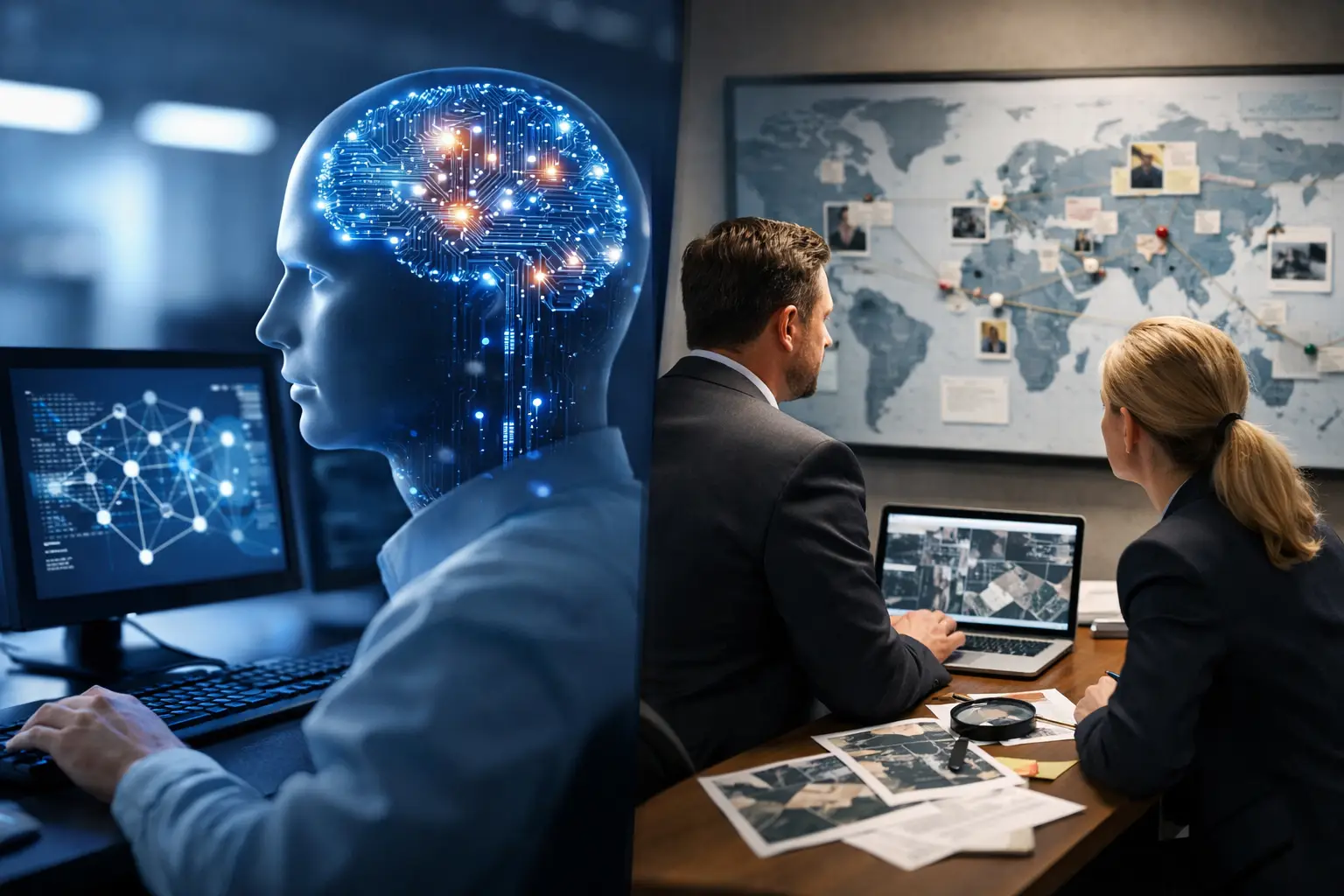
A board receives a market-entry brief built from hundreds of public sources in hours. It looks comprehensive, current and persuasive. Yet a single misidentified subsidiary, an outdated regulatory notice or a coordinated influence campaign can alter the recommendation entirely. That is the practical distinction behind AI research vs OSINT: not simply speed versus manual effort, but the difference between information processing and defensible intelligence.
For leaders operating in contested, regulated or high-consequence environments, the question is not which method is superior in isolation. It is how each should be used, governed and verified so that a decision can withstand scrutiny after it has been made.
AI Research vs OSINT: The Core Difference
AI research uses artificial intelligence to find, retrieve, summarise, classify, compare and synthesise information. Depending on the system and access available, it may work across documents, news coverage, filings, databases, transcripts, internal records and other structured or unstructured material. Its principal advantage is scale. AI can reduce an initial research task from days to hours, identify recurring themes across large corpora and expose relationships that an analyst might not immediately see.
OSINT – open-source intelligence – is a disciplined intelligence process that draws on publicly available information. It is not synonymous with searching the internet. Proper OSINT begins with a defined intelligence requirement and proceeds through source assessment, collection, corroboration, analysis, attribution and reporting. It asks not only what a source says, but who produced it, why it exists, when it was created, how it travelled and whether it is independently supported.
The distinction matters because AI is a capability, whereas OSINT is a methodology and professional discipline. AI can accelerate OSINT collection and analysis. It can also generate a plausible-looking answer without establishing whether the underlying claim is accurate, complete or material to the decision at hand.
Why Fast Answers Can Create Slow Decisions
Senior teams rarely lack information. They lack confidence in what deserves attention, what can be safely discounted and what must be acted on now. A generic AI output may provide a useful starting point, but it often obscures the provenance and quality of its claims. Where the model has not accessed a source directly, or where its knowledge is incomplete, a concise response can create unjustified certainty.
This is particularly consequential in due diligence, geopolitical risk, infrastructure planning, investment analysis and stakeholder mapping. Consider a proposed partnership with a regional operator. AI may quickly surface corporate records, press coverage and social-media activity. An OSINT-led assessment would go further: checking beneficial ownership across jurisdictions, distinguishing an official account from an impersonator, evaluating the credibility of local reporting, identifying conflicts between disclosures and assessing the relevance of each finding to the partnership decision.
The objective is not to make research slower. It is to prevent avoidable rework, escalation and reputational exposure later. A fast answer that cannot be traced, tested or explained to a regulator, investment committee or minister is not decision-ready intelligence.
AI’s strengths are real
Used with discipline, AI provides meaningful operational advantage. It can scan extensive document sets, translate material across languages, extract entities and dates, compare versions of policy documents, detect anomalies in patterns of reporting and produce structured research briefs. It is also valuable for formulating alternative hypotheses and identifying gaps in an analyst’s initial line of enquiry.
In time-sensitive situations, these capabilities can materially improve the speed of situational awareness. During a supply disruption or fast-moving policy change, an AI-enabled research process can help a team establish the emerging picture quickly enough to shape its response.
But speed should not be confused with validation. AI is highly effective at accelerating the first pass. It is less reliable as the sole judge of source credibility, causal significance, intent or strategic consequence. Those are analytical questions that require context, domain knowledge and accountable human judgement.
OSINT provides the evidential discipline
OSINT gives the research process its audit trail. It requires analysts to assess source reliability separately from the apparent credibility of the information itself. A well-regarded publication may report an unverified allegation; a low-profile local filing may provide a decisive factual detail. The analyst must understand both.
This discipline also addresses a common weakness in automated outputs: the flattening of uncertainty. In intelligence work, confidence levels matter. A finding supported by primary documents and multiple independent sources should be presented differently from an emerging indicator based on partial reporting. Conflating the two encourages poor risk calibration.
OSINT is not infallible, nor does public availability make information ethically uncomplicated to use. Analysts must operate within applicable law, organisational policy and clear standards of proportionality. The ability to collect information does not automatically create a legitimate reason to collect, retain or act upon it.
The Real Comparison: Capability, Method and Accountability
The most useful way to frame AI research versus OSINT is through three executive questions.
First, what must be known? If the requirement is broad landscape mapping, early trend detection or rapid document triage, AI can generate significant leverage. If the requirement concerns a named counterparty, a sensitive claim or a decision with legal, financial or political consequences, the threshold for corroboration should be much higher.
Second, what would make the finding reliable enough to act upon? This determines the collection plan, source hierarchy and verification standard. Primary records, official statements, direct evidence and independently corroborated reporting generally carry more weight than recycled commentary or algorithmically generated summaries.
Third, who is accountable for the judgement? An AI system can help produce analysis, but it cannot own the strategic decision or defend the reasoning in a high-stakes meeting. Human analysts and leaders remain responsible for defining materiality, challenging assumptions, recording uncertainty and deciding what action follows.
This is why a simple choice between AI and OSINT is misleading. The stronger model combines them: AI for speed, breadth and analytical assistance; OSINT for provenance, verification and structured judgement; and experienced sector specialists for context, implications and recommendations.
Building a Decision-Ready Intelligence Process
A reliable process starts before collection. The intelligence requirement should specify the decision to be made, the time horizon, the stakeholders affected and the consequences of being wrong. “Assess market risk” is too vague. “Determine whether regulatory, ownership and local stakeholder risks could delay entry within the next 18 months” is actionable.
AI can then support the collection and triage stage, rapidly organising material around that requirement. Crucially, every material assertion should retain a clear evidential path. Analysts need to be able to return to the original source, assess its date and provenance, and determine whether another independent source confirms or contradicts it.
Verification should focus effort where it matters most. Not every background fact requires the same level of scrutiny. Claims that affect valuation, legal exposure, security, licence to operate or public trust demand more rigorous corroboration than low-impact contextual details. This risk-based approach protects both pace and analytical quality.
The final output should separate facts, assessed judgements, assumptions and unresolved questions. It should explain what has changed, why it matters and what leadership can do next. A lengthy source inventory is not a strategic intelligence product. Nor is a polished narrative that conceals weak evidence.
At GVI, this hybrid approach is designed to turn the speed of AI into verified, decision-ready intelligence – with human analysis retained where judgement, context and accountability are indispensable.
Where the Hybrid Model Matters Most
The case for combining AI-enabled research with OSINT is strongest when the operating environment is complex and the cost of error is high. In a cross-border acquisition, for example, public data may be fragmented across registries, languages and legal systems. AI can accelerate extraction and comparison, while analysts investigate ownership links, political exposure, litigation history and local market signals.
In crisis response, AI can help monitor a rapidly expanding information environment. OSINT practice is essential for distinguishing verified developments from rumour, stale content and deliberately manipulated narratives. The difference can shape whether an organisation communicates, pauses operations, engages stakeholders or waits for confirmation.
For policy and geopolitical work, the hybrid model also prevents a narrow focus on formal announcements. Decisions are often signalled through consultation documents, procurement activity, parliamentary debate, regional reporting, corporate behaviour and shifts in stakeholder language well before a formal change is enacted. AI helps identify those signals; expert intelligence analysis determines whether they represent noise, momentum or a genuine inflection point.
The most valuable research does not merely answer the question asked. It clarifies which assumptions are carrying the decision and which indicators leaders should watch as conditions change. That is where AI research and OSINT, properly combined, move beyond efficiency and become a source of strategic control.