
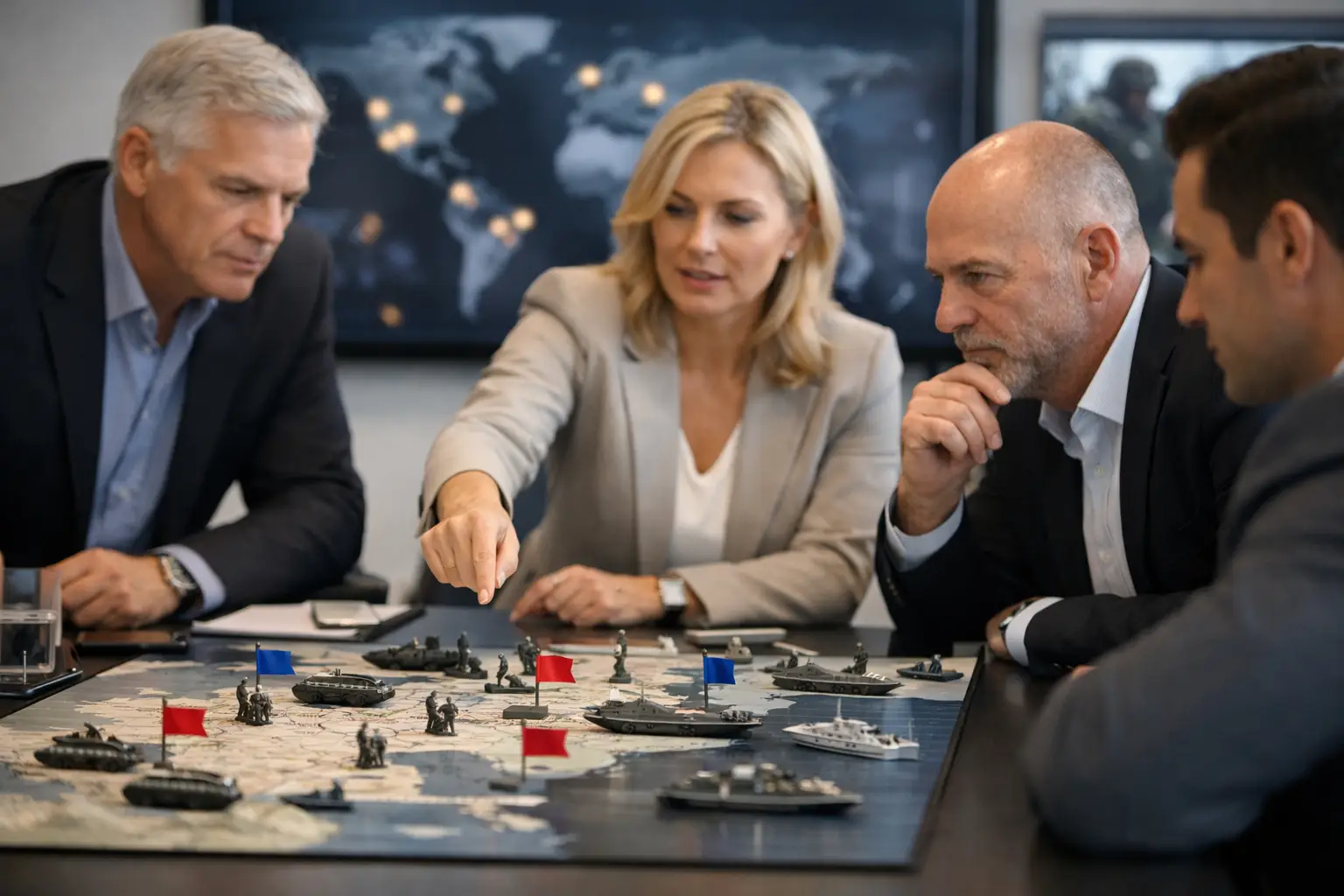
A market-entry plan can appear sound until a regulator changes position, a competitor cuts price, a partner withdraws support, or a regional crisis disrupts the operating model. An executive war gaming workshop creates a controlled setting in which leadership teams test those pressures before they become live events. Its purpose is not to predict the future with false precision. It is to expose the assumptions, decisions and dependencies that will determine whether an organisation can respond with pace and control.
For senior leaders, the value lies in decision quality. A well-designed simulation turns fragmented signals into credible scenarios, puts competing interests into the room, and forces choices that conventional strategy sessions often defer. The result should be a clearer view of what to protect, where to invest, which indicators to monitor, and who has authority to act when conditions change.
What an executive war gaming workshop is designed to do
War gaming is sometimes mistaken for a creative brainstorming exercise or a theatrical crisis simulation. Neither description is sufficient. At executive level, it is a structured decision exercise built around a strategic question with material consequences.
That question may concern an acquisition, an energy transition, a sensitive stakeholder campaign, market entry, a supply-chain exposure, a policy shift, or a deteriorating geopolitical environment. Participants take the roles of their own organisation, competitors, regulators, customers, investors, partners and other relevant actors. They work from an evidence-led scenario, assess incentives and constraints, and respond to developments in successive rounds.
The workshop is effective because it replaces the single internal view with an interactive model of a contested environment. Leadership teams must consider not only what they intend to do, but how other actors are likely to interpret and counter that action. This is where strategic plans are most often found wanting: they describe an organisation’s moves without adequately accounting for the moves of others.
The aim is not consensus for its own sake. Productive disagreement is often the signal that a critical assumption has finally become visible. The facilitator’s task is to keep that disagreement anchored in evidence, decision rights and consequences.
When a war game earns its place on the agenda
A simulation is most valuable when the decision is consequential, uncertainty is high, and the organisation retains meaningful choices. If the course of action is already fixed, or the issue is purely operational, a war game may add little beyond conventional planning.
It is particularly useful when leaders face strategic interdependence. For example, an infrastructure investor assessing a new jurisdiction may need to understand how local political actors, communities, financiers, regulators and rival bidders could react to one another. A single risk register cannot capture those interactions. A war game can.
It also has a role before a crisis. Organisations often commission scenario work after a disruption has exposed an obvious weakness. The stronger use case is pre-emptive: testing a strategy while there is still time to change investment sequencing, build relationships, adjust communications, establish contingencies or define escalation thresholds.
That said, urgency changes the format. A board preparing for an imminent decision may need a concentrated half-day exercise focused on a narrow set of choices. A complex, multi-market issue may justify preparation over several weeks and a full-day workshop with detailed intelligence packs. The design should follow the decision, not a standard template.
The intelligence foundation determines the quality of play
A convincing simulation begins well before participants enter the room. Weak preparation produces familiar outcomes: teams rely on stereotypes, dominant voices substitute confidence for evidence, and the exercise confirms what leaders already believe.
The starting point should be a precise decision statement. For instance: should the organisation proceed with a proposed investment under current conditions; which market-entry posture creates the best balance of opportunity and exposure; or what response is warranted if a strategic partner changes alignment? This discipline prevents the workshop from becoming an unfocused discussion about risk.
From there, the research must identify the actors that can shape the outcome, their stated positions, underlying incentives, capability, constraints, relationships and likely triggers. Public information may be abundant, but abundance is not intelligence. Claims need to be verified, sources assessed, contradictions resolved and gaps made explicit.
AI-enabled research can accelerate the scanning and synthesis of large, dispersed information environments. Yet it should not be treated as an autonomous source of judgement. In high-stakes settings, human verification and contextual analysis remain essential, especially where source reliability, political signalling, stakeholder intent or reputational implications are contested. The workshop must be built on intelligence participants can interrogate and trust.
How to structure an executive war gaming workshop
The strongest workshops are deliberately constrained. They focus attention on a limited number of strategic questions, a small set of pivotal actors and a scenario horizon relevant to the decision at hand.
Set the decision frame and rules of engagement
Participants need clarity on what is being tested, what is within scope and what decisions may follow. The sponsor should state whether the exercise is intended to challenge an existing strategy, select between options, prepare a response plan or identify conditions that would change the current course.
Roles should be assigned with care. Teams representing external actors must be given enough intelligence to act credibly rather than caricature their assigned stakeholder. It is also useful to separate the organisation’s core team from an independent challenge team, particularly where internal alignment is already strong. This reduces the risk that the workshop becomes a defence of the preferred plan.
Build pressure through decision rounds
Most effective simulations unfold in rounds. The opening round establishes the baseline: each actor states objectives, constraints and initial posture. Subsequent rounds introduce developments such as a regulatory intervention, hostile media coverage, a financing shock, competitor action, public opposition or an operational disruption.
These developments should not be random. Each inject should test a specific dependency or assumption within the strategy. If success depends on a regulator maintaining a favourable timetable, the exercise should examine what happens when that timetable slips. If value depends on partner commitment, the simulation should force a credible competing offer or political pressure.
The real test is not whether participants can name risks. It is whether they can make trade-offs under pressure. Would the organisation delay an announcement to protect a relationship? Commit additional capital to preserve momentum? Change its public position? Escalate engagement with government? The answers reveal where a strategy has insufficient flexibility or unclear authority.
Capture decisions, signals and thresholds
A workshop should produce more than a record of discussion. At the end of each round, the facilitator should capture decisions made, assumptions challenged, information gaps, early-warning indicators and actions required.
The most useful outputs are often thresholds. A threshold links an observable condition to a pre-agreed action: if a specified policy signal emerges, engage at ministerial level; if a supply route faces a defined disruption, activate an alternative operating plan; if stakeholder sentiment crosses an agreed point, revise the engagement approach. Such thresholds convert scenario insight into operational readiness.
Common failure modes and how to avoid them
The first failure is treating the war game as an event rather than part of a decision process. A compelling discussion that produces no owner, no trigger and no follow-through will not improve strategic resilience. The exercise should connect directly to board papers, investment gates, risk governance and contingency planning.
The second is overloading the room with detail. Intelligence must be sufficiently rigorous to support realistic behaviour, but an executive team does not need a research archive. The briefing should distinguish decisively between what is known, what is assessed and what remains uncertain. Precision matters more than volume.
A third failure is allowing hierarchy to determine the answer. Seniority is necessary for decisions, but it can suppress the challenge that makes a simulation worthwhile. Skilled facilitation creates room for dissent, requires evidence for assertions and keeps participants focused on the scenario rather than organisational politics.
Finally, avoid confusing plausibility with probability. A low-probability scenario may still warrant attention if the consequences are severe and the organisation has little recovery capacity. Conversely, not every imaginable risk merits a strategic response. The right level of preparation depends on exposure, reversibility, available mitigations and the cost of inaction.
From simulation to decision-ready action
The workshop’s value is realised after the room clears. Within days, leadership should receive a concise decision brief that identifies the strategic options tested, the assumptions that did not hold, the strongest adversarial or stakeholder responses, and the actions required to improve readiness.
For some organisations, this will lead to a revised strategy. For others, the strategy may stand, but with stronger monitoring, clearer authority and more credible contingency arrangements. Both are valid outcomes. The point is not to manufacture change; it is to ensure that leaders understand the basis on which they are accepting risk.
GVI approaches strategic simulations as an intelligence discipline: combining AI-enabled research with human verification, sector context and structured challenge. That approach matters when the difference between an interesting scenario and a decision-ready insight is the quality of evidence beneath it.
The most useful closing question is therefore not, “What could go wrong?” It is, “What would we do differently if this signal appeared tomorrow?” When leaders can answer that question with clarity, ownership and evidence, the organisation is better prepared to act with confidence.