
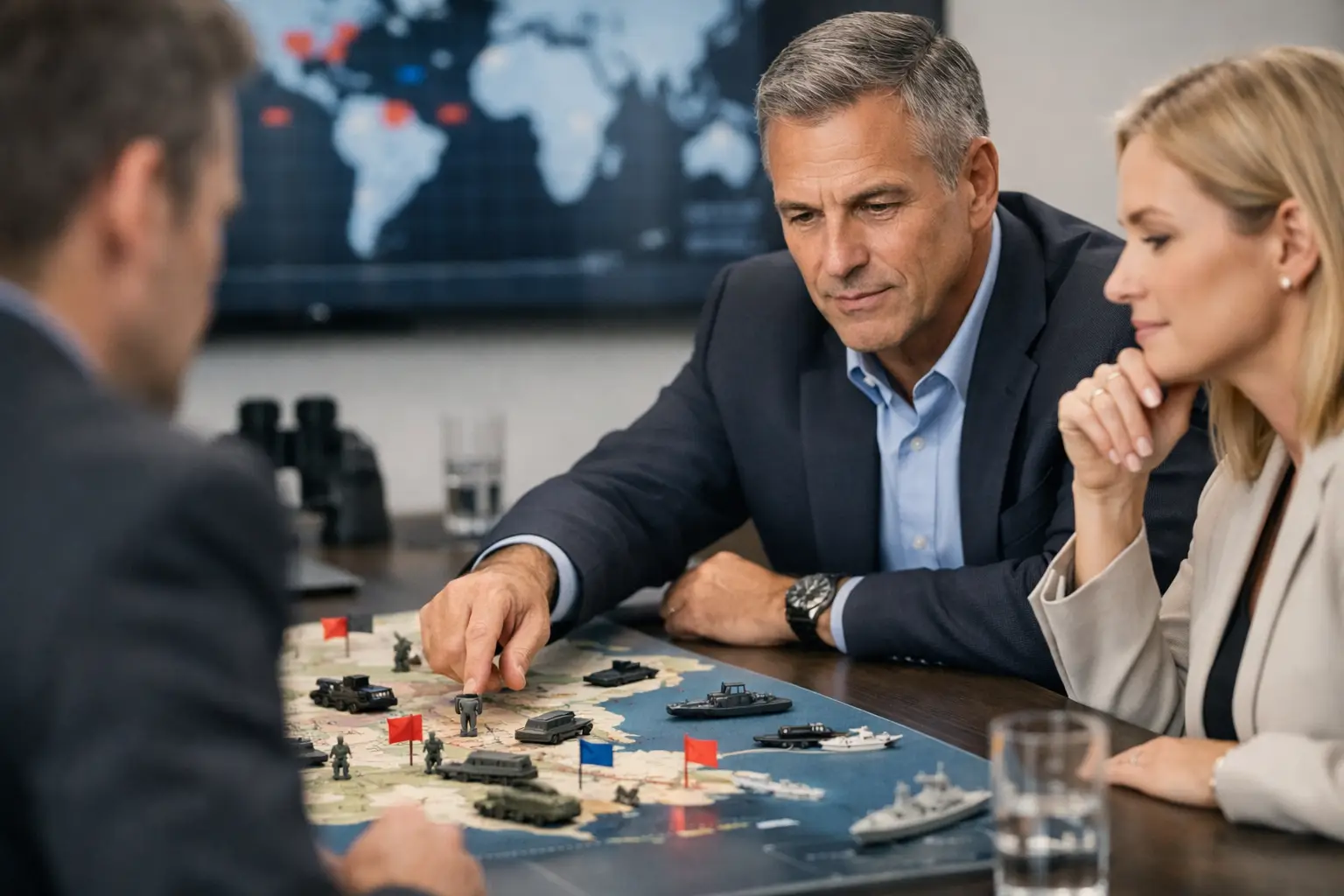
A market-entry plan may look compelling until a competitor cuts pricing, a regulator changes the operating conditions, a critical supplier fails, or an allied stakeholder declines to support the move. The purpose of learning how to run strategic war games is not to predict one future with false precision. It is to expose the decisions, dependencies and assumptions that determine whether a strategy holds under pressure.
For senior leaders, a well-designed war game creates a controlled environment for testing consequential choices before capital, reputation or political leverage are committed. It turns uncertainty into observable decision points. Done poorly, it becomes an expensive workshop where participants defend existing plans. Done well, it produces decision-ready intelligence: clearer triggers, stronger contingencies and a more realistic view of adversaries, partners and constraints.
Start with a decision that genuinely matters
Strategic war games should not begin with a broad request to “explore the future”. Begin with a decision that leadership may need to make, and define the consequences of getting it wrong. This might be whether to enter a contested market, acquire a sensitive asset, respond to a policy shift, protect a critical supply chain, or position an organisation during an escalating crisis.
A useful framing question has three elements: the decision, the time horizon and the uncertainty. For example: should the organisation commit to a major infrastructure investment over the next 18 months if a hostile competitor, a changing regulatory regime and local opposition can each alter the economics of the project?
This discipline prevents scope creep. It also ensures the simulation produces an output that can be used by an executive committee, board or public-sector leadership team rather than a collection of interesting observations.
The objectives should be explicit. A war game may be designed to test a preferred strategy, identify early-warning indicators, compare response options, assess stakeholder behaviour or establish crisis authorities. These are related but distinct outcomes. Trying to achieve all of them in one session usually dilutes the analysis.
Build the intelligence base before the simulation
A war game is only as credible as the intelligence that informs it. Participants should receive a concise, verified briefing that sets out the current operating picture: market conditions, actor incentives, legal and regulatory boundaries, operational dependencies, known vulnerabilities and material unknowns.
The objective is not to burden participants with a large research pack. It is to establish a common factual baseline and identify where judgement is required. Separate confirmed facts from assessed judgements and unresolved questions. That distinction protects the exercise from a familiar problem: treating an assumption as evidence because it has appeared repeatedly in internal discussions.
AI-enabled research can accelerate the collection and synthesis of open-source material, especially where the issue spans multiple jurisdictions, languages or stakeholder groups. It should not be treated as a substitute for verification. High-stakes simulations require human review of source quality, recency, incentive bias and contextual meaning. A plausible but unverified claim can distort the entire game.
At this stage, identify the critical assumptions behind the existing strategy. These are often more revealing than the strategy itself. They may include expectations about competitor restraint, financing availability, government support, customer loyalty, alliance cohesion or the speed of operational recovery. Each assumption should be framed so it can be tested during play.
Design a strategic war game around actors, not abstractions
The strongest games model the actors that can shape the outcome, rather than generic categories of risk. A competitor is not simply “the competition”; it has commercial incentives, constraints, internal politics, risk appetite and preferred tactics. A regulator has statutory duties, public pressures and a tolerance for intervention. A community coalition, investor group or state-backed supplier may have objectives that are only partly visible to the organisation.
Assign participant teams to these actors. Ask each team to pursue its own objectives using the information and capabilities it would plausibly have. The organisation’s own team should not receive privileged insight into other teams’ plans. Without this separation, participants unconsciously optimise the scenario for a coordinated outcome that would not exist outside the room.
A core design team should set the scenario boundaries, adjudicate disputed actions and introduce developments known as injects. Injects may include a leaked document, sudden policy announcement, cyber incident, financing shock, media narrative, supply interruption or leadership change. They should be plausible, evidence-led and directly relevant to the decision under examination.
The aim is not theatrical surprise. Each inject should test an important dependency or force a trade-off. If an event does not change a team’s choices, it is probably noise.
Use a realistic time horizon
Most strategic war games work best over a defined period, such as six months, two years or five years. The appropriate horizon depends on the decision. Crisis response may require hours or days; infrastructure, diplomacy and market positioning may require several years.
Use turns to move the scenario forward. At each turn, teams assess the new situation, decide what they will do, allocate limited resources and explain their rationale. The control team then adjudicates likely consequences and introduces the next development. This creates strategic interaction rather than a sequence of presentations.
How to run strategic war games without reinforcing hierarchy
Senior participants add value because they understand the consequences of decisions. They can also constrain the exercise if junior colleagues defer to them or if established positions cannot be challenged. The facilitator must create a disciplined separation between rank and evidence.
Set clear rules at the outset. Participants should argue from the perspective of their assigned actor, state assumptions openly, distinguish confidence levels and challenge claims without personalising disagreement. The purpose is not to win the room. It is to improve the organisation’s understanding of how the environment may respond.
A neutral facilitator is essential. They should keep teams focused on objectives, prevent one voice from dominating, press for the rationale behind decisions and ensure that inconvenient evidence is considered. In particularly sensitive exercises, an independent intelligence and simulation partner can provide both analytical distance and confidentiality discipline.
Do not allow the organisation’s team to solve every problem with more funding, communications or executive escalation. Constraints are what make a war game useful. Limit available capital, political goodwill, time, specialist capacity and management attention. A strategy that only works under unlimited resources is not a strategy leadership can rely on.
Capture decisions, signals and thresholds as the game unfolds
The most valuable output is rarely a ranking of which team “won”. It is a record of where the strategy became fragile, which actions changed the trajectory and what signals would indicate that conditions are moving in a particular direction.
For each turn, capture the decision made, the assumptions behind it, the expected result and the assessed consequence. By the end of the game, this evidence trail reveals patterns that an end-of-day discussion can miss. Perhaps the competitor repeatedly exploited a dependency the organisation had overlooked. Perhaps a stakeholder’s response was more decisive than expected. Perhaps a risk assumed to be low-probability became critical once two smaller events occurred together.
The closing session should focus on implications for live decisions. Leaders should identify which assumptions remain credible, which require further intelligence collection, which mitigations should be funded and which decision triggers warrant formal monitoring. It is often useful to distinguish actions that can begin immediately from contingency measures that should only activate when a defined threshold is crossed.
Avoid forcing consensus where the evidence does not support it. A documented disagreement, with the assumptions on each side made explicit, is more useful than superficial agreement. It tells leadership precisely what must be monitored or researched before commitment.
Turn the exercise into an operating capability
A one-off war game can sharpen a specific decision. Repeated simulations can strengthen institutional judgement. The difference lies in what happens after the workshop.
Convert findings into a concise leadership brief with a clear view of the tested strategy, principal vulnerabilities, adversary and stakeholder moves, early indicators, decision thresholds and recommended actions. Assign ownership for each follow-up item. If no one is responsible for monitoring the indicators or revising the plan, the insights will remain theoretical.
Refresh the intelligence base as conditions change. A scenario designed around last quarter’s market, policy or stakeholder landscape can quickly lose value. Periodic, shorter exercises are often more effective than waiting for another major off-site meeting, particularly in volatile sectors.
The strongest strategic war games do not create certainty. They give leaders something more practical: a tested understanding of where confidence is justified, where it is conditional, and what they must see before acting. When the next consequential decision arrives, that preparation can be the difference between reacting to events and shaping the available choices.