
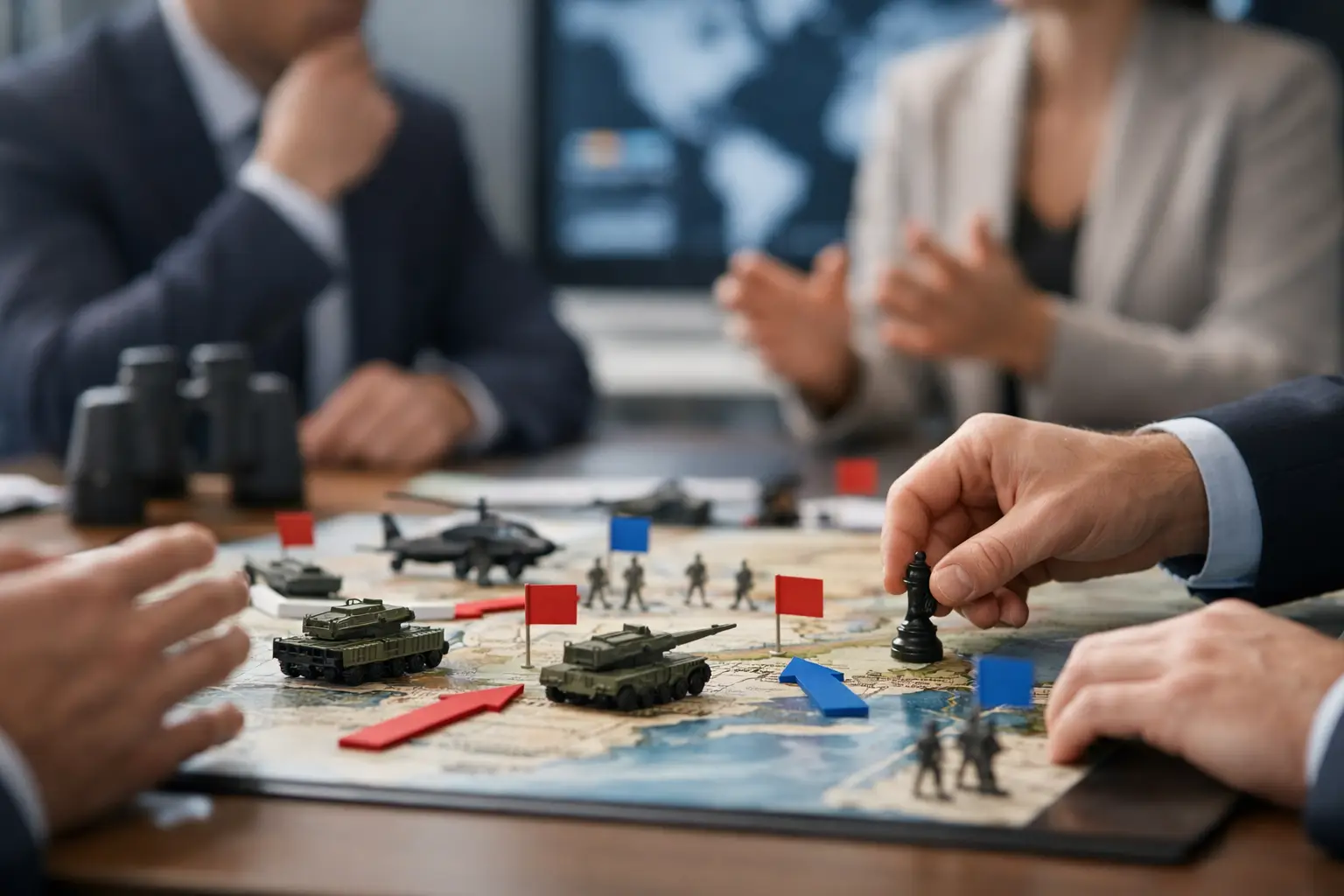
A board has approved a market-entry plan. Capital has been allocated, partners identified and a public announcement drafted. Then a competitor cuts pricing, a regulator changes its interpretation of a rule, or a local stakeholder coalition shifts the terms of engagement. The plan may still be viable, but the assumptions beneath it are no longer sufficient.
When should firms use war gaming? Before uncertainty becomes an expensive operational reality. A well-designed war game gives leaders a controlled setting in which to test a strategic decision against the likely behaviour of competitors, regulators, investors, customers and other stakeholders. It does not predict the future. It exposes where a strategy is dependent on an optimistic view of how others will respond.
For senior teams, the value is not theatrical simulation. It is decision-ready intelligence: a disciplined way to identify vulnerabilities, assess choices under pressure and establish actions that remain credible across more than one plausible future.
When Should Firms Use War Gaming?
Firms should use war gaming when a decision is consequential, contested and shaped by actors outside their direct control. These conditions commonly arise before a major investment, market entry, restructuring, transaction, policy shift, product launch or crisis response.
The method is particularly useful where conventional planning produces a single preferred forecast. Forecasts are necessary, but they can create a false sense of precision when competitor intent, political developments, supply constraints or public sentiment could materially alter the outcome. War gaming introduces active opposition and competing incentives into the analysis. It asks not only whether the plan works, but how capable actors may try to prevent, exploit or outmanoeuvre it.
Timing matters. The highest value usually comes before a public commitment, contract signature or irreversible capital decision. At that stage, leaders still have room to redesign the proposition, sequence activity differently, reserve contingency funding or decide that the risk-reward case does not hold. Running a simulation after a decision has been locked in can still improve execution, but it is less likely to challenge the strategic premise.
Before entering a contested market
Market-entry research often establishes demand, addressable market size and the regulatory baseline. It may not adequately reveal how incumbents will defend their position. A war game can examine likely price responses, distribution pressure, legal challenges, talent moves, lobbying activity and targeted customer retention efforts.
This is most valuable where the market is concentrated, politically sensitive or dependent on a small number of critical relationships. A firm entering an infrastructure, energy or financial-services market, for example, may face a different competitive reality from the one suggested by public data alone. The central question becomes: what would established players do first, and what would they do if the entrant’s first move succeeds?
Before committing to a major strategic bet
Large capital programmes and strategic transformations often depend on a chain of assumptions. Demand must arrive on schedule. Financing must remain available. Suppliers must perform. The regulatory environment must remain broadly stable. Internal delivery capacity must hold.
War gaming is appropriate when failure in one part of that chain could change the whole investment case. It allows teams to test triggers, second-order effects and management responses. If a supplier fails, which customer commitments become exposed? If interest rates remain higher for longer, where does the programme cease to create value? If a rival secures a strategic partnership, should the firm accelerate, reposition or pause?
The objective is not to manufacture pessimism. It is to distinguish manageable risk from risks that demand a different strategic posture.
When stakeholder behaviour can determine the result
Some decisions are technically sound but operationally vulnerable because stakeholder interests have been underestimated. A policy proposal may invite opposition from groups that were not treated as material. A transaction may create concerns among employees, customers or public authorities. A development programme may encounter local resistance that changes cost, timing and reputation.
In these cases, war gaming forces leaders to see the decision from outside the organisation. Participants take on the incentives, information and constraints of stakeholders, rather than simply listing them in a risk register. This often reveals that a communications response alone will not be enough. The underlying proposition, governance model or engagement sequence may need to change.
What a Strategic War Game Should Test
A serious war game is built around a live decision, not a generic scenario. Its design should begin with the strategic question leadership must answer. For example: should we enter now or build partnerships first? What conditions justify continuing this investment? How should we respond if a competitor challenges our position? Which stakeholder concerns could derail implementation?
The exercise then combines verified intelligence with explicit hypotheses. Teams should understand the relevant actors, their objectives, their capabilities, the constraints they face and the signals that might indicate a change in behaviour. Without this grounding, simulation risks becoming an internal debate populated by stereotypes.
A useful design tests several plausible pathways rather than one dramatic event. One pathway may assume an orderly competitive response; another may introduce regulatory intervention or a supply shock; a third may explore a coordinated challenge by competitors and stakeholders. The aim is to identify decisions that perform acceptably across conditions, as well as those that work only if everything goes to plan.
The output should be specific. Leadership needs critical assumptions that require monitoring, early-warning indicators, decision thresholds, contingency actions and accountable owners. A finding such as “competition may increase” is not actionable. A finding that a competitor is likely to use a particular channel, within a defined period, and that the firm should pre-authorise a commercial response if named indicators emerge is operationally useful.
When War Gaming Is Not the Right Tool
War gaming is not a substitute for basic research, financial modelling or executive judgement. If the organisation lacks a clear strategic question, reliable baseline information or authority to act on the findings, a simulation can create activity without clarity.
It is also disproportionate for routine decisions with limited downside and few external dependencies. Not every pricing adjustment, operating change or product enhancement needs a multi-team exercise. A short red-team review may be more appropriate where the issue is narrow.
Equally, firms should avoid using war games to validate a decision already made. Senior sponsorship matters because the process must permit inconvenient conclusions. If participants believe the expected answer is known, they will protect the plan rather than test it. The result may look rigorous while leaving the organisation exposed to exactly the assumptions it intended to challenge.
Designing the Exercise for Executive Value
The quality of a war game depends less on spectacle than on preparation and discipline. Participants need sufficiently detailed intelligence to act credibly in role, while the facilitation must prevent the most senior voice from determining the outcome prematurely. A cross-functional group is usually essential: commercial leaders may see customer dynamics differently from legal, operational, risk and public-affairs colleagues.
AI-enabled research can materially improve preparation by rapidly mapping competitor statements, policy developments, market signals and stakeholder narratives. Yet speed should not be confused with certainty. In high-stakes settings, source verification and expert contextualisation remain vital. A simulation built on inaccurate claims about an actor’s capabilities or intent will produce confident but unreliable conclusions.
GVI approaches strategic simulation as an intelligence discipline. The purpose is to convert fragmented evidence into a structured challenge to leadership assumptions, then translate the result into choices that can be acted on with confidence.
A strong exercise also has a defined horizon. Some decisions require a 90-day competitive simulation; others require examination of a two-year regulatory and geopolitical environment. Trying to model every possibility dilutes the exercise. The relevant horizon is the period in which the organisation can still influence the outcome or must commit resources.
The Leadership Test
The practical test is straightforward: would the organisation be materially better prepared if it understood how other actors might react before it acted? If the answer is yes, war gaming deserves consideration.
Used at the right point, it changes the quality of strategic discussion. Leaders move beyond asking whether their preferred plan is attractive and begin asking what evidence would prove it wrong, what signals demand intervention, and what choices remain available if the environment turns. That is where foresight becomes an operating capability rather than a presentation slide.